lunedì 19 gennaio 2009

ECOBAY: photovoltaic waterfront in Dubai

Claudio catalano Architect

Location: Dubai Area waterfront 340.000 sqm, Length forehead sea 3.180 mt, Residential area 112.000 useful sqm, Gemstone hotel n. 10 towers h. 90 mt, area sqm 25.000 for every tower, Mall and mixed use 400.000 sqm, Bay tower hotel height 170 mt. area mt. 35.000, All the structures will be endowed with panels and systems of photovoltaic façade, Other systems photovoltaic will be integrated in the park, Energy solar Dissalatoris will furnish necessary water to the growth of the varied arboreal kinds, The whole waterfront will exclusively be pedestrian and the automobiles will have access to the inferior level with situated parking lot on the central axle under the mall and the blocks residential elevators and mobile staircases will directly bring to the plan of the park.Aggiungi immagine

mercoledì 14 gennaio 2009

Finalità del progetto Science&Design


Science&design nasce come open network di scienziati, designer, artigiani, e artisti, la cui funzione è quella di favorire la produzione di nuove idee, tecnologie e contenuti. Questo nucleo sarà circondato da un ampio gruppo di professionisti nel mondo degli affari, che tramuteranno in prodotto il valore delle idee. Il progetto intende porre in comunicazione diretta il settore artigiano e industriale con le nuove opportunità tecnologiche offerte dalla ricerca sui materiali, in modo da sviluppare una rete di imprese che possa integrarsi come fornitori e partner nel campo delle bio e nanotecnologie e dei materiali interattivi. Il progetto science&design avrà come scopo fondamentale la trasmissione della conoscenza attraverso la rete e workshop e seminari formativi. Le imprese artigiane, i designer e tutti gli attori della progettazione e della produzione possono ottenere una maggiore visibilità e credibilità sul mercato, contatti facilitati con il mondo delle imprese scientifiche, un’offerta più efficace di prodotti e servizi specifici oltre allo studio di nuovi progetti innovativi.Con la rete science&design i ricercatori, le imprese e i laboratori possono trovare un unico referente per le proprie necessità, maggiore facilità di ricerca di una particolare impresa, e proposte di sviluppo di nuovi prodotti e servizi per future ricerche scientifiche.

Mind Chair


http://www.betatank.net/mind-chair.html


A Sensory Substitution Project
You can't see with your skin. Or can you?
In 1969, Prof. Paul Bach-y-Rita attached an array of solenoids to the back of a dentist's chair and produced astonishing results. "You don't see with the eyes. You see with the brain," he observed.*
By building the Mind Chair we are reviving this technology for sensory substitution. A movie camera is attached to an enhanced grid of 400 solenoids installed in the back of the Mind Chair. People are able to sit in the chair, close their eyes and concentrate on the images which are vibrated into their backs by the solenoids.
Science labs have been investigating this technology as a means of helping the blind. We think it shows the brain's ability to process alternative inputs, opening many more possibilities.
Could we see text messages or images internally? What if we can process more than one visual signal at a time? Could we educate our brains differently from childhood?
The working Mind Chair is our research prototype. With it we investigate these questions.


http://www.betatank.net/mind-chair-polyprop.html
Mind Chair – 'Polyprop'
Beta Tank + Peter Marigold

The Mind Chair 'Polyprop' is a model of an ordinary polypropylene chair which is fitted with sensory substitution technology.
It suggests a future in which every class room makes use of our ability to see with our skin. Children lean back in order to experience a more involved way of learning. – A learning experience which is supported by internal images and personal concentration phases.


lunedì 5 gennaio 2009

Philips interactive concepts

Morpho butterflies


Many butterfly species use light-interacting structures on their wing scales to produce color in a way that suggests a novel model for producing environmentally-benign coloration with unique and valuable properties. The cuticle on the scales of these butterfly species’ wings are composed of nano-sized, transparent, chitin-and-air layered structures that, rather than statically absorb and reflect certain light wavelengths as pigments and dyes do, selectively cancel out certain colors through wavelength interference while reflecting others, depending on the exact structure and interspatial distance between diffracting layers. This system of producing color allows for the dynamic control of light flow and wavelength interaction, which butterflies rely upon for camouflage, thermoregulation, and signaling. Human-made systems of structurally-produced color are now being designed which do not require the toxic heavy-metals or manufacturing methods common to many pigments and dyes (e.g., for iridescent fabrics and cosmetics), and to create high-performance electronic color displays by actively varying the interspatial distances of light-interacting layers (e.g., for cell phones), which can change colors rapidly, remain vibrant under low-light conditions, and require less energy than other electronic display methods.

sabato 3 gennaio 2009

The Soft House

http://www.inhabitat.com/2008/06/12/solar-harvesting-textiles-energize-soft-house/


The SOFT HOUSE by KVA MATx transforms the household curtain into a set of energy harvesting textiles that distribute renewable electrical power, adapt to the changing space needs of living and working in a compact home and generate up to 16,000 watt-hours of electricity—about half of the daily power needs of an average household in the United States.KVA MATx was commissioned by the Vitra Design Museum to present designs for the pre-fabricated SOFT HOUSE and develop full scale energy harvesting textile prototypes. The SOFT HOUSE research group at KVA MATx demonstrated how the existing performance parameters and material possibilities of organic photovoltaic (OPV) nanotechnology could offer a hybrid energy and space making solution by providing renewable DC power for solid state lighting and work tools such as laptops, digital cameras, WiFi and cell phones.Translucent movable curtains along the SOFT HOUSE perimeter convert sun light into energy throughout the day, shade the house and form an insulating air layer for the building envelope. Integrated into the design of a skylight, a central energy harvesting curtain can be lowered to create an instant habitable room. Folded upward, the central curtain becomes a suspended soft luminous chandelier that defines the open living area with integral solid state lighting.The principles of the SOFT HOUSE energy network--simplicity, adaptability, and intelligent co-operation among individual contributing elements--are extended into the architectural design and fabrication of the SOFT HOUSE. Parametric design software, developed for the SOFT HOUSE project, allows the homeowner to customize the energy density of the textiles according to need and guides the relationship of building form to site. Multiple flat, pre-fabricated bamboo plywood beams interlock to form a grid shell structure which can be customized through digital fabrication allowing the SOFT HOUSE to accommodate a range of different site orientations. http://kvarch.net/

venerdì 2 gennaio 2009

Feedback


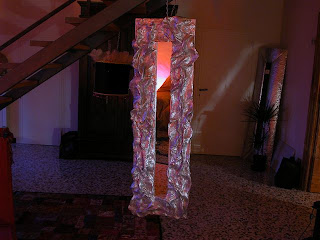
Il lavoro della designer Milena L’annunziata http://www.milastudio.it/ è incentrato sulla trasformazione della materia nella sua intima tessitura, deforma la struttura superficiale e interna per conferirgli espressione plastica, un procedimento artigianale che nella serie di specchi qui proposti non è dato per la sola fruizione visiva ma soprattutto tattile: toccare lo specchio significa toccare una proiezione di se stessi per stabilire un collegamento fra l’io e la materia.
IL tatto trasmette sensazioni così come le riceve: veniamo a contatto con noi stessi. Il tatto è attivo e passivo, stabilisce un collegamento con una realtà fuori di sé, richiede fiducia nel mondo.
Lo specchio tattile, da accarezzare crea un feedback di stimoli sensoriali che sottendono percezioni dello spazio con un raggio d’azione diverso, la lontana riflessione dello specchio e il ravvicinamento dell’esperienza tattile, dal pubblico al privato , l’esperienza visiva è in fondo un esperienza pubblica condivisibile mentre l’atto di toccare entra nella sfera privata ravvicinata , la cornice diventa allora medium, fra illusione e corporeità e crea un cortocircuito sensoriale fra l’essere e l’apparire.